The difference between a good private event and a genuinely exceptional one is rarely a single decision. It is almost always the accumulation of many smaller ones — each element chosen with intention, each layer of the experience considered not in isolation but in relation to everything around it. A magnificent venue with indifferent food is a disappointment. Perfect food in a space that doesn't work is frustrating. Extraordinary food and a stunning venue, underserved by inattentive staff, falls short of what it could have been.
Private luxury events in Lisbon have the potential to be among the finest in Europe. The city offers a concentration of exceptional raw ingredients — dramatic venues, extraordinary local produce, world-class musicians, a culture of hospitality that is warm rather than performative — that few cities can rival at any price point. But realising that potential requires knowing what to include, in what combination, and at what standard. This guide covers every element, in the order that matters.
1. The Venue: Where Everything Begins
Venue selection shapes every other decision you will make. The right space determines what catering is possible, what entertainment works, how your guests move and feel, and what atmosphere you can realistically create. Get it right and everything else becomes easier. Get it wrong and no amount of investment in food, staff, or entertainment will fully compensate.
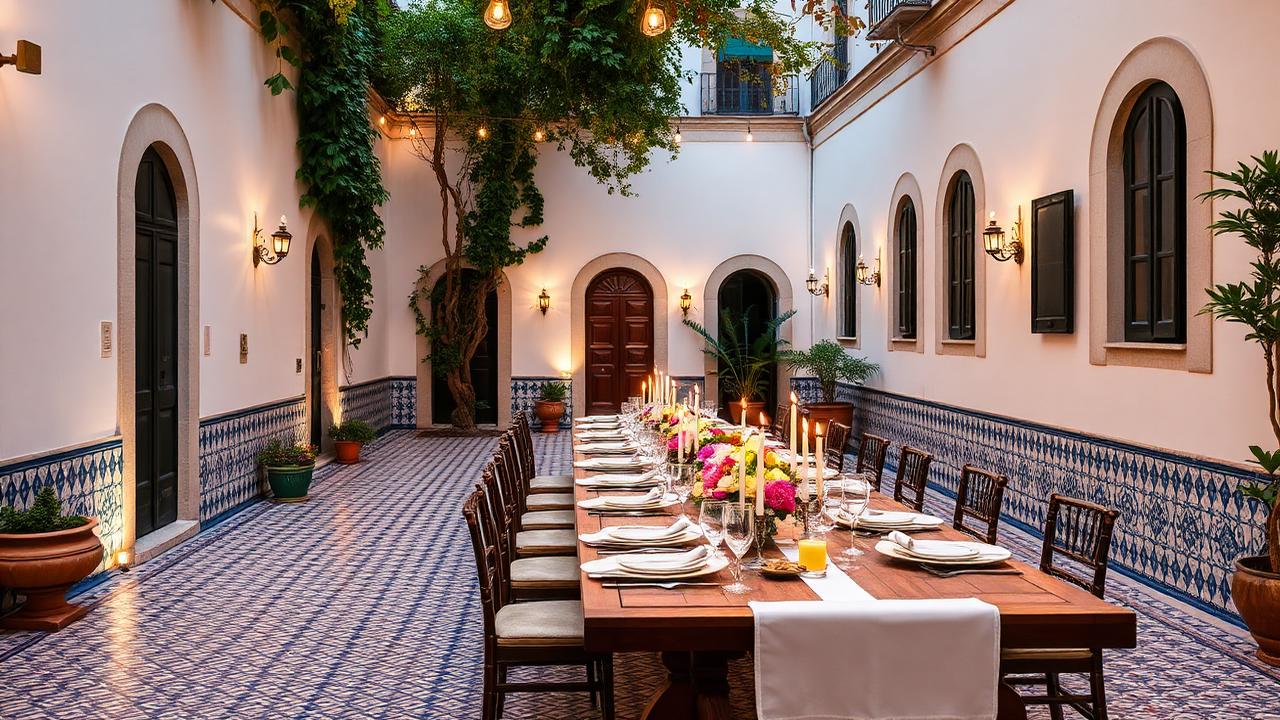
Lisbon's private event venues span a range that is genuinely extraordinary. At one end: palace interiors with gilded ceilings, azulejo-tiled walls, and gardens that have hosted centuries of significant gatherings. At the other: converted industrial spaces in Marvila and Beato that offer a raw, contemporary grandeur with nothing like it elsewhere in southern Europe. Between these poles sit rooftop terraces with panoramic Tejo views, baroque quinta estates in the hills above Sintra, cliffside villas on the Arrábida coast, and private dining rooms carved into centuries-old wine cellars beneath the city.
The question is not which venue is the most impressive in absolute terms, but which is most right for your event — your group size, your desired atmosphere, your catering ambitions, your entertainment plans. A venue that seats three hundred people rarely works for forty guests, however beautiful it may be. A space with no outdoor access is the wrong choice when the evening is warm and the stars are out. Match the venue to the event, not the other way around.
The best venue for your event is not necessarily the most famous one. It is the one that makes your specific gathering feel inevitable.
2. A Private Chef: The Centre of the Experience
Food is almost always the element that guests remember most clearly, and discuss most readily afterwards. It is also the element most often compromised by defaulting to in-house catering packages or generalist caterers who treat events as a volume exercise. For a private luxury event in Lisbon, neither is acceptable.
Working with a private chef changes the nature of the food entirely. A skilled private chef builds a menu around your event — your guest preferences, any dietary requirements, the season, the venue, the tone you want to create — and sources ingredients accordingly. In Lisbon, this means access to Atlantic seafood landed that morning at Matosinhos or Setúbal, vegetables and herbs from the small market gardens of the Alentejo or Ribatejo, sheep's cheeses from the Serra da Estrela, and wines from regions — Colares, Carcavelos, Palmela — that most international guests will never have encountered.
The result is food that could only have been served at this event, in this city, at this time of year. That specificity is precisely what elevates a private dinner from a pleasant meal to a genuine experience. It is also what makes it memorable — because memorable food is almost always food that was clearly made for you, with care, from something real.
3. Professional Waitstaff: The Standard Your Event Deserves
Service is the invisible architecture of a great event. When it is done well, guests feel looked after without being aware of the mechanics. Glasses are refilled before they are empty. Plates arrive and are cleared at exactly the right moment. A guest with a dietary need is accommodated without a fuss. The rhythm of the evening flows because someone is conducting it, quietly and precisely, behind the scenes.
When service is done poorly, the opposite is true: guests wait, glasses sit empty, the pacing of the meal becomes awkward, and the overall impression of the event diminishes regardless of the quality of the food, the venue, or the company. Professional waitstaff who are experienced in private event service — not restaurant service, which is a different discipline — understand how to read a room, adapt to a host's preferences, and maintain an unhurried attentiveness that never tips into intrusion. For a luxury event, this is not optional. It is foundational.
4. A Host: The Human Face of Your Event
For events involving guests who do not all know one another, or for any event where the host is also a guest and cannot be in two places at once, a professional host is one of the most transformative investments you can make. A skilled event host does something that cannot be delegated to a checklist or a briefing document: they hold the room. They make introductions, smooth awkward moments, guide the narrative of the evening, and ensure that every guest feels genuinely welcomed rather than simply present.
In Lisbon, a great host also brings something more specific: genuine knowledge of the city, its culture, its food and wine, and its stories. They can tell a guest why the azulejo tiles on the walls of the venue were made in the eighteenth century, what the fado singer is singing about and why it matters, where to go tomorrow morning for the best pastel de nata in the city. This kind of warmth and contextual knowledge turns an event into an education — and makes your guests feel that they are in extraordinarily good hands.
5. Entertainment: The Emotional Layer
The best entertainment at a private event is not a performance that your guests watch from a distance. It is something that enters the atmosphere of the evening and changes it — that makes the air feel different, that creates a moment nobody was quite expecting, that gives the evening a shape and a peak it would not otherwise have had.
In Lisbon, the most compelling option for many events is live fado. Heard in the right setting — a candlelit courtyard, a vaulted stone interior, a palace garden at midnight — fado is capable of producing something close to silence in a room full of people, followed by a quality of conversation that tends not to happen without it. It does not require guests to understand Portuguese. The emotion in the voice and the guitar carries it entirely.
Beyond fado, the options are extensive. A classical guitar trio for a reception. A jazz quartet for dinner. Traditional Portuguese folk musicians whose instruments and repertoire have existed for centuries. A contemporary DJ who understands that the difference between a playlist and a performance lies in reading the room rather than the tracklist. The choice depends on the event — its formality, its duration, its guest profile — but entertainment should always be considered as an integral part of the event design, not an optional addition.
6. Curated Experiences: The Details That Distinguish
The most memorable private luxury events are those in which the guests feel that the evening was made specifically for them — that someone thought carefully about who they are, what they might love, and what they have probably never encountered before. Curated experiences woven into the fabric of an event are the most effective way to create this feeling.
In Lisbon, this might mean a guided azulejo tile-painting session before dinner, led by an artisan whose family has practised the craft for generations. It might mean a private wine tasting of small-production Portuguese wines that are unavailable outside the country, led by a sommelier who can explain not just what is in the glass but where the vineyard sits and why the soil matters. It might mean a sunset boat journey on the Tejo that delivers guests to a private dinner by water rather than by car — an arrival that nobody will forget.
These moments are not embellishments. They are the event. They are what guests carry away with them and describe when someone asks what was so extraordinary about that evening in Lisbon.
7. Private Transport: Seamless from Start to Finish
Transport is consistently the most underestimated element of private event planning, and consistently one of the most damaging when it goes wrong. Guests who have travelled internationally to attend your event, who arrive at an unfamiliar airport in an unfamiliar city and find no car waiting, or who spend thirty minutes at the end of a beautiful evening attempting to find a taxi, experience a frustration that colours their memory of everything that preceded it.
Private transport — properly arranged, properly briefed, and properly timed — removes this entirely. A meet-and-greet at arrivals with a driver who knows the guest's name and hotel. A fleet of vehicles that arrives at the venue entrance at precisely the right moment and does not leave until the last guest is safely on their way. A driver who knows Lisbon's streets well enough to adapt to unexpected traffic, and who treats the journey as part of the hospitality rather than a necessary inconvenience.
For larger groups or multi-day events, coordinated group transport — a coach or fleet of vehicles moving guests between venues, dinners, and experiences — adds another layer of ease that guests appreciate more than they may articulate. The event begins the moment the car door closes. Make that moment count.
8. Group Experiences: When Your Event Is a Programme
For multi-day events — corporate retreats, milestone celebrations, destination weddings, incentive trips — the individual dinner or evening is one element within a broader programme. Group event planning requires a different approach: cohering a sequence of experiences into a narrative that builds over days rather than hours, managing the logistics of moving a group through a city and its surroundings, and maintaining a standard of quality across multiple venues, suppliers, and moments.
Lisbon is exceptionally well suited to this kind of extended event. Within an hour of the city, the geography shifts dramatically: the beaches of the Arrábida, the palaces and forests of Sintra, the vineyards of the Setúbal Peninsula, the hilltop fortress of Palmela. A three-day programme might begin with a private dinner in the city, continue with a morning in Sintra and lunch in a quinta vineyard, and conclude with a sunset boat trip and a beach dinner on the Arrábida coast. Each day distinct, each day unmistakably Portuguese, and together forming something that no single evening could achieve.
Putting It Together: The Standard That Matters
Every element listed here — venue, chef, waitstaff, host, entertainment, experiences, transport — can be sourced in Lisbon. What varies, significantly, is the standard at which each can be delivered and the coherence with which they can be combined. A private luxury event is not a collection of independently booked services. It is a designed experience in which every element has been chosen with the others in mind, briefed consistently, and executed to a standard that rises rather than falls across the duration of the event.
That coherence requires deep local knowledge: knowing which chefs work best in which spaces, which entertainment suits which guest profiles, which venues have the logistical infrastructure to support the kind of service you want to offer. It also requires relationships — the kind that take years to build and that cannot be replicated by an online search the week before an event.
If you are planning a private luxury event in Lisbon — whether a dinner for twenty or a programme for two hundred — the best place to start is a conversation about what you want your guests to feel. Everything else follows from there.